






Word-of-mouth built the contracting industry, and it still matters. But it no longer decides who gets the call. A homeowner with a leaking roof or a tripped breaker now searches Google first, almost every time, and hires from whoever shows up credible, close, and trustworthy in those first few results. If your contracting business is not one of them, the referral you would have earned goes to a competitor you have never met.
SEO for contractors is how you make sure that stops happening. Done properly, it is not a collection of tricks or a technical checklist. It is a system: your Google Business Profile, your website, your content, and your off-page authority all working together to make search engines trust you enough to recommend you. This guide walks through that system in full, the same way we build it for every general contractor, roofer, electrician, plumber, and remodeler we work with, so you understand exactly what good contractor SEO looks like and what it takes to build it.

What Is SEO for Contractors?
Search engine optimization for contractors is the practice of improving a contracting company’s website and online presence so it ranks higher in search results when homeowners look for the services that company provides. It covers everything from the words on your service pages to your Google Business Profile, your reviews, your backlinks, and the technical health of your site. When those pieces work together, search engines rank you above the competition for the searches that actually turn into booked jobs.
It is worth being precise about what “SEO” means in this context, because the word gets used loosely. Contractor SEO is not advertising. You do not pay for a click or a placement. It is the organic, unpaid side of search, built by earning relevance and trust over time rather than renting visibility by the month. That distinction matters because it changes the timeline, the investment, and the payoff: SEO compounds, while paid ads stop the moment you stop paying.
How Contractor SEO Is Different From Generic SEO
A dentist, a law firm, and a roofing company are all local businesses, and a generalist SEO agency will often treat them identically. That is a mistake, because contractor SEO carries realities most other industries do not share. Demand is not steady; it spikes hard after a storm, a cold snap, or a heat wave, and a contractor’s SEO strategy has to be built for those surges, not just for steady-state traffic. Trust signals carry unusual weight, since a homeowner is inviting a stranger into their home, so being licensed and insured, showing real project photos, and carrying genuine reviews matter more here than in almost any other local vertical. And most contractors serve a defined radius rather than an entire city, which makes precise local and service-area targeting a requirement, not a nice-to-have.
A home service business that understands these differences builds pages, content, and campaigns around them. One that does not ends up with a generic local SEO setup that could belong to any small business, and generic setups rarely outrank specialists.
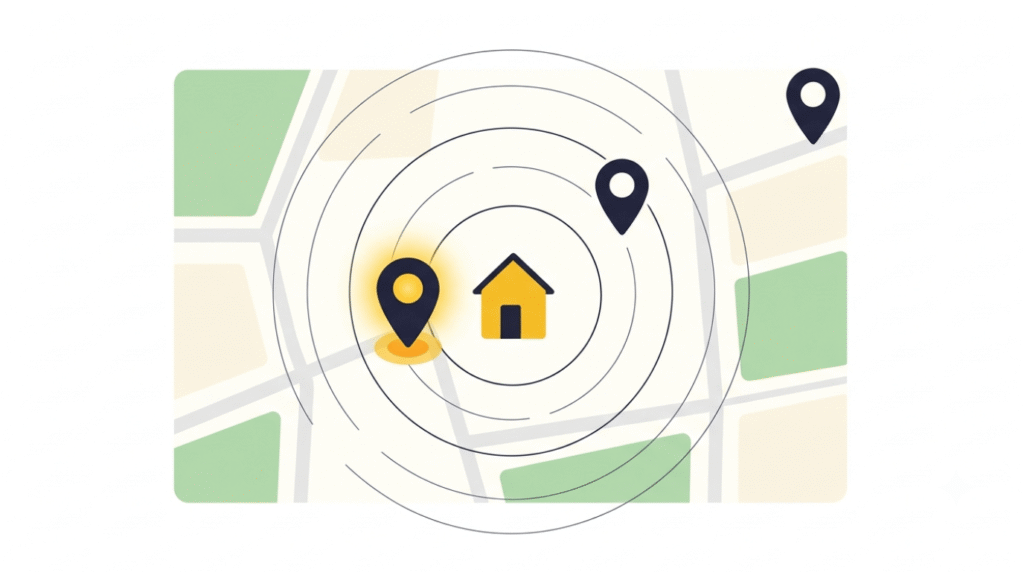
Local SEO vs. National SEO: Why Proximity Wins for Contractors
National SEO competes for visibility across an entire country, usually for e-commerce or purely informational searches. Local SEO competes for visibility within a specific city, county, or service area, and for a contractor, that is nearly always the fight that matters. Google itself has said its local ranking algorithm weighs three specific factors: proximity, relevance, and prominence. Proximity is how close your business is to the person searching or to the location they specify. Relevance is how well your business profile and website match what they are looking for. Prominence is how well-known and well-regarded your business is, based on signals like reviews, citations, and links.
Understanding those three factors changes how you prioritize your work. A contractor obsessing over national keyword rankings while ignoring their Google Business Profile is optimizing for a fight they were never in. The homeowner searching “roof repair near me” is not comparing you to a company three states away. They are comparing you to the four or five roofers Google decides are close enough, relevant enough, and prominent enough to show them first.

The Four Pillars of Contractor SEO
Contractor SEO works when it is treated as a system, not a set of disconnected tactics. Chase backlinks while your Google Business Profile sits half-finished, and you cap your own results. Write excellent content on a slow, poorly structured website, and homeowners bounce before they read it. Every piece of the system supports the others, which is why we organize contractor SEO into four pillars that have to be built together, not in isolation.
The four pillars are your Google Business Profile and local trust signals, your website’s foundation and technical health, your content and the expertise it demonstrates, and your off-page authority built through backlinks and partnerships. Underneath all four sits the actual method: we call it contextual density optimization, and it is how we decide exactly where to focus effort on any given page so it earns relevance in the eyes of both search engines and, increasingly, the AI systems that summarize search results. The rest of this guide walks through each pillar in turn.

Pillar 1: Google Business Profile and Local Trust Signals
For most contractors, no single asset does more work than the Google Business Profile. It is what appears in the Map Pack when someone searches “electrician near me.” It is often the first thing a homeowner sees before they ever visit your website. And it is free, which makes an incomplete or neglected profile one of the most expensive mistakes a contracting business can make. This is also the foundation of the local SEO for contractors work we do for every client, since almost everything else in this pillar builds on it.
Optimizing Your Google Business Profile
A complete, accurate Google Business Profile is the foundation of local SEO for contractors. That starts with claiming and verifying the listing, then filling in every available field: your business name exactly as it appears elsewhere, your service areas, your hours, and a description that clearly states what you do and where you work. Choosing the right primary category matters more than most contractors realize; a roofing company listed under “General Contractor” as its primary category is telling Google, and every homeowner searching, the wrong thing about the business. Secondary categories can broaden your visibility, but the primary category is what Google weighs most heavily.
Beyond the basics, an active profile outperforms a static one. Real photos of completed jobs, not stock images, build immediate trust. Regular Google Posts, even short updates about a recent project or a seasonal offer, signal that the business is active. Answering the Google Q&A section proactively, rather than waiting for a stranger to answer incorrectly, keeps the information homeowners see accurate and controlled by you.
Citations, NAP Consistency, and Directory Listings
A citation is any online mention of your business name, address, and phone number, commonly shortened to NAP. Search engines use the consistency of that information across the web as a trust signal: if your address is listed one way on your website and a different way on Yelp, that inconsistency quietly erodes the confidence Google has in your business data. Getting listed accurately on directories like Yelp, Angi, Houzz, and the Better Business Bureau, along with community platforms like Nextdoor and search engines beyond Google like Bing Places, builds a web of consistent confirmation that your business is exactly where and what it says it is.
This is unglamorous work, and it is also one of the areas contractors most commonly get wrong, usually by accumulating old citations from a previous address, a former business name, or a defunct phone number. Auditing and correcting those inconsistencies is often one of the fastest wins available in a contractor SEO campaign.
Reviews and Reputation Management
Online reviews function as both a trust signal to homeowners and a ranking signal to Google. A contracting business with dozens of recent, detailed, positive reviews is read by both audiences as more trustworthy than one with a handful of old ones. The businesses that handle this well make asking for reviews part of their process, right after a completed job while the experience is fresh, rather than an occasional afterthought.
Reputation management is not just collection; it is response. Replying to every review, including the negative ones, professionally and specifically, shows both the reviewer and every future reader that the business is engaged and stands behind its work. A single well-handled negative review, addressed publicly and resolved, often builds more trust than a wall of five-star ratings with no visible engagement behind them.

Pillar 2: Website Foundation and Technical SEO
Your Google Business Profile earns the click. Your website has to earn the call. A contracting company can dominate local search results and still lose the lead if the site that click lands on is slow, confusing, or built without the technical foundation search engines need to understand and rank it.
Site Architecture: Service Pages and Location Pages
The single most common structural mistake in contractor websites is cramming every service onto one page, or worse, leaving them out entirely and hoping a paragraph on the homepage does the job. Search engines rank pages, not businesses, which means each core service you offer, whether that is roof replacement, panel upgrades, or kitchen remodeling, deserves its own dedicated service page built to answer everything a homeowner would want to know about that specific job.
The same logic applies to geography. If you serve multiple cities or a wide county, location pages that speak specifically to each service area, rather than one generic “service area” page, give search engines a clear, relevant page to rank for each local search. Once that page architecture exists, internal linking between service pages, location pages, and supporting content is what ties the site together, using descriptive anchor text rather than vague phrases like “click here,” so both users and search engines understand how the pages relate.
On-Page SEO: Keywords, Titles, and Schema Markup
On-page SEO is the set of signals you control directly on each page: the keywords you target, the title tag and meta description that appear in search results, the heading structure that organizes your content, and the schema markup that translates your page into a format search engines and AI systems can parse precisely. For a contractor, that means implementing LocalBusiness schema so search engines understand your business type, service area, and hours, Service schema on each service page so the specific offering is unambiguous, Review or AggregateRating schema to surface your star rating directly in search results, and FAQPage schema on any page with a genuine question-and-answer section.
Getting the fundamentals right, a clear title tag that includes your service and location, a meta description that gives someone a reason to click, and headings that logically break down the page, does more for most contractor websites than any advanced technical tactic. It is unglamorous, and it is also where a surprising number of contractor sites still fall short.
Core Web Vitals, Mobile-First, and Site Speed
Most contractor searches happen on a phone, frequently while the homeowner is standing next to the exact problem they are trying to solve. A slow-loading site loses that person before the page finishes rendering. Google measures this directly through Core Web Vitals, a set of metrics covering how quickly a page becomes usable and how stable it feels while loading, and factors that measurement into rankings under its mobile-first indexing approach, which evaluates the mobile version of your site as the primary version, not a secondary one.
The practical fixes are usually straightforward: compress images, choose reliable hosting, minimize unnecessary scripts, and make sure the site runs on HTTPS with a valid SSL certificate, since Google treats an unsecured site as a trust liability. An XML sitemap, submitted through Google Search Console, helps search engines find and index every page efficiently, particularly important once a site’s architecture expands into multiple services and locations. If your current site cannot meet these standards, our contractor web design team builds sites engineered to pass Core Web Vitals from launch.

Pillar 3: Content and E-E-A-T
A contracting business that only lists its services is easy to ignore. One that consistently answers the questions homeowners are actually asking, clearly and specifically, becomes the site search engines treat as the expert. That distinction is what Google calls E-E-A-T: experience, expertise, authoritativeness, and trust. It is not a ranking factor you can stuff into a meta tag. It is earned through the substance of what you publish.
Keyword Research and Search Intent for Contractors
Effective keyword research starts by separating search intent into categories, because a homeowner typing “how much does a bathroom remodel cost” wants a different page than one typing “bathroom remodeling contractor near me.” The first is informational, researching before committing. The second is commercial, ready to compare and hire. Building content and pages for both intents, rather than only the transactional ones, captures homeowners earlier in their decision and keeps your business visible through the entire journey.
Long-tail keywords, the longer, more specific phrases homeowners type when they know roughly what they want, convert at a higher rate than short, competitive head terms and are far easier to rank for. A page built around “cost to replace a 30-year-old roof” will usually outperform a generic “roofing services” page for the homeowner who is close to making a decision.
Content That Builds Topical Authority
Topical authority is what happens when a website covers a subject so thoroughly that search engines start treating it as the default answer for that entire topic, not just individual keywords. For a contractor, that means going beyond a handful of service pages into genuinely useful supporting content: cost guides, maintenance tips, seasonal advice, and answers to the questions homeowners search before they are ready to hire. A pillar page like this one, with cluster content branching off it into specific services and trades, is exactly how that authority gets built deliberately rather than by accident.
The opposite mistake is just as common: publishing thin, duplicate content across multiple location or service pages by swapping out a city name and calling it done. Search engines recognize that pattern quickly, and it actively suppresses rankings across every page involved rather than helping any of them.
Proof Content: Case Studies, Project Galleries, and Video
Claims are cheap. Evidence is not. A detailed case study that walks through a real project, the challenge, the approach, and the result, does more to build trust than a paragraph of adjectives ever will. Before-and-after project galleries give homeowners something concrete to evaluate, and short video content, a walkthrough of a finished job or a quick client testimonial, adds a layer of authenticity that text alone cannot. None of this content needs to be elaborate. It needs to be real, specific, and easy to find.
Certifications, licenses, warranties offered, and years in business all belong somewhere prominent too. Homeowners scan for these signals quickly, and their absence raises more doubt than their presence builds confidence. Building a genuine library of proof content is exactly the kind of work our content marketing for contractors team handles, from cost guides to project showcases that double as ranking assets.

Pillar 4: Off-Page Authority and Link Building
Everything covered so far happens on your own site. Off-page authority is what other sites say about you, and it remains one of the strongest trust signals search engines use to decide who deserves to rank first.
Backlinks and Digital PR for Contractors
A backlink is a link from another website to yours, and search engines read a link as a vote of confidence, weighted by how authoritative and relevant the linking site is. A mention from a respected local news outlet or an industry publication carries far more weight than a dozen links from irrelevant, low-quality directories. Digital PR, actively pitching a real story, a completed project, a community contribution, to local journalists and trade publications, tends to earn exactly this kind of high-value link, alongside the credibility and visibility that comes with the mention itself.
Domain authority and page authority are useful shorthand metrics for judging the strength of a potential linking site, but they are estimates, not Google’s own numbers. The underlying principle is simpler than any metric: earn links from real, relevant sources, and avoid the temptation of cheap, bulk-purchased links that put your entire site at risk.
Supplier, Vendor, and Community Partnerships
Some of the most natural, durable backlinks for a contractor come from relationships you already have. Suppliers and manufacturers often maintain a “find a contractor” or “certified installer” directory that links back to approved partners. Local chambers of commerce, trade associations, and community sponsorships offer the same kind of relevant, authoritative link, along with real local visibility. Building a systematic link building for contractors strategy around these relationships produces links that are not just SEO assets but genuine business relationships.

SEO for Contractors in the Age of AI Search
Search itself is changing faster than at any point in the last decade. A growing share of homeowners now ask ChatGPT, Google’s AI Overviews, or Perplexity for a recommendation instead of scrolling through ten blue links, and increasingly, the answer they get is a short, direct list rather than a page of results to click through. That shift is called generative engine optimization, or GEO, sometimes referred to as answer engine optimization, and it is quickly becoming as important as traditional SEO for the contractors who want to stay visible.
The good news is that GEO does not replace the work in this guide, it builds directly on top of it. The same clear entity signals, structured data, authoritative content, and trust signals that earn you a ranking in Google’s organic results are what earn you a citation inside an AI-generated answer. Voice search follows a similar logic, since assistants pull from the same well-structured, clearly answered content. Contractors who wait for this shift to fully arrive before acting will spend next year wondering why a competitor they have never heard of keeps getting recommended by name. Our dedicated GEO services for contractors build this layer specifically, using the same authority foundation described throughout this guide.
How Long Does SEO Take to Work for Contractors?
SEO is not instant, and any guide or agency promising otherwise is not being straight with you. Most contractors start seeing meaningful movement in organic traffic growth and keyword rankings within three to six months, with the strongest, most durable ranking positions compounding over six to twelve months as authority builds. Some wins arrive faster: a properly optimized Google Business Profile can lift local pack visibility within a matter of weeks, since it does not depend on the same slow accumulation of authority that organic rankings do.
The realistic way to think about it is as a curve, not a switch. Early months focus on fixing foundational issues and building out missing pages. Middle months bring the first visible ranking gains for easier, less competitive keywords. Later months bring compounding growth as content, links, and reviews accumulate, and the cost per lead from organic search steadily declines while paid channels stay flat.
How Much Does SEO Cost for Contractors?
SEO cost for contractors varies with market size, competition, and how many services and locations need coverage, but most established campaigns run between $1,500 and $5,000 per month. A contractor in a single, less competitive market with two or three services needs a narrower scope than one competing across a major metro with a dozen service lines.
The right way to evaluate that spend is against return on investment, not against the invoice alone. An SEO budget that costs $2,500 a month but generates even two or three additional booked jobs, at a typical project value in the thousands of dollars, delivers a return that dwarfs the monthly cost many times over. The comparison that matters is not SEO against nothing. It is SEO’s compounding organic traffic growth against the cost of buying every one of those leads through ads or shared-lead services indefinitely.
Measuring Contractor SEO: The Metrics That Actually Matter
Vanity metrics are easy to report and easy to feel good about. They are also frequently disconnected from revenue. A serious contractor SEO strategy is measured on the numbers that actually predict booked jobs.
Keyword rankings and ranking position tell you whether the work is moving in the right direction. Organic traffic growth tells you whether more of the right people are finding you. Click-through rate and impressions from Google Search Console reveal how compelling your listings are once they appear. But the metrics that matter most sit further down the funnel: call tracking and lead attribution connect specific keywords and pages to actual phone calls, and conversion rate tells you whether the traffic you are earning turns into requested estimates. Bounce rate and dwell time offer a useful secondary signal, showing whether homeowners are actually engaging with a page or leaving immediately. Every one of these numbers should ultimately roll up into one question: what did this cost per booked job, and how does that compare to every other way you generate leads?
5 Contractor SEO Mistakes That Waste Time and Money
Even well-intentioned SEO efforts go wrong in predictable ways. Five mistakes account for most of the wasted budget we see when we audit a new client’s site.
- Duplicate or thin content across location pages. Copying the same paragraph across ten city pages with only the city name changed does not fool search engines, and it actively suppresses rankings for every page involved.
- Inconsistent NAP information. An old address on one directory and a current one on your website quietly erodes the trust search engines place in your business data.
- Keyword stuffing. Repeating a keyword unnaturally in an attempt to rank for it reads as spam to both search engines and homeowners, and it usually backfires.
- Ignoring technical foundations. A beautifully written page that loads slowly on mobile loses the homeowner before they read a word of it.
- Treating SEO as a one-time project. SEO is a compounding system, not a purchase. Businesses that stop investing after the first few months typically see their gains plateau and slowly erode as competitors keep building.
SEO for Contractors by Trade
Every trade has its own search patterns, its own seasonal surges, and its own high-value keywords, which is why we build trade-specific strategy rather than a one-size-fits-all template. Our SEO for roofing contractors work centers on the split between storm-driven emergency searches and planned, insurance-related replacement research. Our SEO for electrical contractors approach separates urgent “no power” searches from higher-ticket, planned work like panel upgrades and EV charger installation. The same trade-specific thinking applies across every home service business we work with, and the underlying four-pillar framework scales into new and even international markets, including the campaigns we run for contractors in competitive markets like Dubai.
DIY Contractor SEO vs. Hiring a Contractor-Only Agency
Everything in this guide can technically be done in-house. Whether it should be is a different question, and the honest answer depends on your time, your crew size, and how quickly you need results. A contractor with the time to learn keyword research, manage a Google Business Profile properly, produce genuine content, and pursue backlinks methodically can absolutely build real organic visibility without outside help. What that path costs is time, and time spent learning SEO is time not spent running jobs.
An experienced SEO agency that works only with contractors brings something a generalist agency and a DIY effort both struggle to match: pattern recognition across dozens of similar businesses, a proven framework instead of trial and error, and the bandwidth to execute all four pillars simultaneously rather than one at a time. That is exactly what we built The SEO Contractor to do, and it is why our clients typically see results faster than self-managed campaigns, without spending their own limited hours learning a second profession. Many of our clients pair this with contractor PPC for immediate leads while the organic strategy in this guide builds underneath it. You can read more about how our team approaches this work on our about page.
See where your business stands today
We will show you exactly where your contracting business ranks, what your competitors are doing better, and what it would take to close the gap. No pressure, no sales pitch.
Talk to a contractor SEO expert

Frequently Asked Questions About SEO for Contractors
What is contractor SEO?
Contractor SEO is the practice of optimizing a contracting company’s website and online presence so it ranks higher in search results when homeowners search for the services that company offers. It covers Google Business Profile optimization, on-page and technical SEO, content, and off-page authority, all working together to drive organic, unpaid visibility.
How is contractor SEO different from regular SEO?
Contractor SEO accounts for realities generic SEO ignores: demand that spikes seasonally or after events like storms, the outsized importance of trust signals like licensing and reviews since homeowners are inviting a stranger into their home, and a defined service area rather than a broad or national audience. A generalist approach misses all three.
How long until I see results from contractor SEO?
Most contractors see meaningful ranking and traffic gains within three to six months, with results compounding over six to twelve months. Google Business Profile improvements can lift local pack visibility within weeks, since that channel does not depend on the same slow authority-building process as organic rankings.
How much should I budget for contractor SEO?
Most established contractor SEO campaigns run between $1,500 and $5,000 per month, depending on market size, competition, and how many services and locations need coverage. The right way to evaluate that spend is against the return from booked jobs, not the invoice in isolation.
Can I do contractor SEO myself?
Yes, technically. A contractor with the time to learn keyword research, manage a Google Business Profile, produce real content, and build backlinks methodically can build genuine organic visibility without outside help. The tradeoff is time: every hour spent learning SEO is an hour not spent running jobs, which is why many contractors eventually bring in a specialist agency.
Does contractor SEO work for AI search tools like ChatGPT?
Increasingly, yes, through a discipline called generative engine optimization, or GEO. The same authority, structured data, and clear content signals that earn strong organic rankings are what get a contracting business cited inside an AI-generated answer, which makes GEO a natural extension of traditional SEO rather than a separate strategy.
Build your contractor SEO strategy with a specialist
The contractors who invest in SEO now will own their local search results for years. Let’s build that foundation together.